How to save OEM manufacturers 20% on costs and avoid delivery delays through precision CNC machining
Introduction
In the competitive landscape of modern manufacturing, Original Equipment Manufacturers (OEMs) grapple with persistent challenges in mass-producing precision components. Common pain points include inconsistent part accuracy. Escalating production costs, and delayed delivery schedules, all of which directly undermine production line efficiency and market competitiveness. The root cause often lies in traditional manufacturing methods, which lack advanced process optimization and automation. Leading to inefficient machining, significant quality fluctuations, and opaque supply chain management. This makes it difficult to meet the stringent demands of modern industry for precision and timeliness.
This article delves into how the integration of high-precision CNC technology. Material science optimization, and automated production lines systematically addresses. These core OEM challenges, offering a triple guarantee of cost control, quality assurance, and on-time delivery. The following sections will explore five key dimensions where precision CNC machining creates tangible value for OEM manufacturers.
Why Does OEM Mass Production Require High-Precision CNC Machining Services?
OEM mass production places unique demands on part consistency, tolerance precision, and traceability. The success of an integrated final product hinges on the flawless replication of thousands, if not millions, of identical components. Traditional machining methods, reliant on manual operation and conventional equipment. Struggle to guarantee this level of uniformity, often resulting in quality variances and bottlenecks.
The Limitations of Conventional Approaches
Conventional manufacturing processes lack the digital control and repeatability essential for modern high volume OEM CNC machining services. Reliance on manual setup, variable tool wear, and operator skill introduces significant production variables. These factors frequently result in higher scrap rates, necessary rework, and costly delays. Ultimately failing to meet the stringent, consistent quality standards demanded for seamless assembly-line integration.
The Paradigm Shift to Digital Precision Manufacturing
Precision CNC Machining represents a fundamental revolution in production methodology. It replaces human-dependent processes with unwavering digital program control, executed by a proficient CNC machining parts manufacturer.
Digital Program Control as the Foundation
This technology is anchored in translating digital design specifications directly into precise machine tool paths. This creates a seamless digital thread from design to finished part, eliminating the inconsistencies inherent in manual operations.
Achieving Microscopic Tolerances and Perfect Consistency
The core outcome of this digital control is the ability to produce every component from the first prototype to the ten-thousandth production piece with identical accuracy. This process reliably achieves the microscopic tolerances and perfect batch-to-batch consistency required for successful OEM parts machining.
The Imperative for Technological Advancement
Industry trends underscore this necessity. Reports from the Society of Manufacturing Engineers (SME) highlight that digital transformation is making precision manufacturing the standard. For OEMs. Partnering with a provider of high precision CNC machining services is no longer optional but a strategic imperative for supply chain resilience. This technological upgrade is crucial for mitigating risk and guaranteeing the successful fulfillment of large-volume orders.
Aluminum vs. Titanium for OEM Parts: How to Choose?
Material selection in Custom Parts Manufacturing is a critical decision impacting performance, lifecycle cost, and application suitability. Aluminum and titanium alloys are two heavyweight contenders in the OEM space, each with distinct advantages.
Aluminum alloys are celebrated for their excellent strength-to-weight ratio. Good machinability, and cost-effectiveness, making them ideal for lightweight and budget-conscious applications like automotive frames and consumer electronics enclosures. Titanium alloys boast superior specific strength, exceptional corrosion resistance, biocompatibility, and higher thermal limits. However, these benefits come with significantly higher raw material costs and greater machining difficulty.
In aerospace, where strength, fatigue resistance, and performance under extreme temperatures are paramount. Titanium is the material of choice for engine components and airframe parts. In medical devices, its biocompatibility makes it indispensable for implants. The decision in the aluminum vs titanium for OEM parts debate should be guided by application-specific requirements and standards, such as those from ASTM International. For many projects balancing performance with total cost, high-strength aluminum series. (e.g., 6061, 7075) often present a more economical solution without compromising integrity.
How Do Automated Production Lines Enhance Efficiency in OEM Batch Processing?
For orders spanning tens of thousands of units, simply speeding up individual part cycle times reaches a physical limit. The true leap in efficiency comes from holistic workflow optimization through Automated Production Lines.
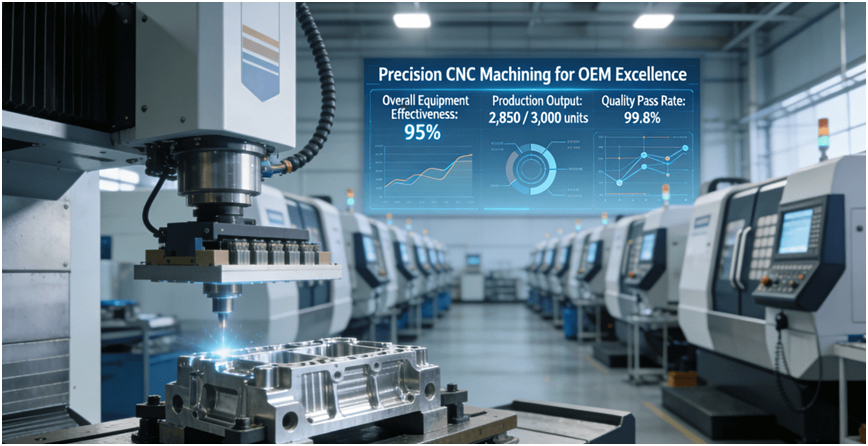
Automation in CNC machining for OEMs manifests in several key areas. Robotic loading/unloading systems enable 24/7 operation. Moving workpieces in and out of machining centers with unwavering precision. Drastically increasing equipment utilization (uptime) by eliminating downtime for shift changes or breaks. In-process inspection systems provide real-time monitoring of critical dimensions. Allowing for immediate corrections and shifting quality control from a “post-process” checkpoint to an “in-process” assurance, significantly reducing the risk of batch rejection.
Furthermore, smart production scheduling systems (MES/APS) synthesize order deadlines, material inventory, and machine status to generate optimal production plans. Maximizing overall factory throughput. Implemented holistically, automation can deliver measurable gains. Such as a 30% increase in capacity and a 25% reduction in labor costs. Most importantly, the stability and predictability introduced by automation are fundamental to ensuring the on-time delivery of large batch orders, giving OEMs greater control over their supply chain.
How to Evaluate a CNC Machining Supplier’s Technical and Quality Systems?
Selecting a competent CNC machining parts factory is a decisive factor for OEM project success. A robust evaluation framework should encompass four pillars: technical capability, material expertise, quality certifications, and process control.
Evaluating Foundational Technical Capabilities
A comprehensive evaluation of a CNC machining parts factory begins with its core technical capabilities. The ability to produce complex OEM machined parts reliably hinges on advanced equipment and deep material expertise. Forming the foundation for manufacturing excellence.
The Critical Equipment Matrix
The supplier’s equipment portfolio is paramount. The presence of advanced machinery, such as 5-axis machining centers and mill-turn systems, is essential. This technology enables the complete machining of intricate components in a single setup. Ensuring superior accuracy and efficiency for complex production runs.
Depth of Material Processing Knowledge
Equally critical is the supplier’s mastered material database. True capability is demonstrated by a proven track record in processing a wide spectrum of alloys. Experience ranging from common stainless steels to challenging high-temperature super alloys reflects a depth of practical knowledge crucial for selecting optimal parameters and ensuring part integrity.
The Framework of Quality and Certification
Formal credentials provide the essential framework for trust and compliance. Industry-specific certifications are a testament to a supplier’s systemic commitment to quality, not merely optional accolades.
Credentials like IATF 16949 for automotive or AS9100D for aerospace serve as validated evidence. They confirm that the supplier has implemented a rigorous quality management system that meets the exacting standards of these sectors. For many OEMs, these certifications are a non-negotiable requirement for partnership, ensuring processes are controlled, consistent, and auditable.
Process Control and Continuous Improvement
Robust Quality Control Systems: A true partner employs Statistical Process Control (SPC) to monitor the stability of key dimensions and Failure Mode and Effects Analysis (FMEA) for proactive risk mitigation. A stringent First Article Inspection (FAI) process and full traceability from raw material to finished part are essential. For OEMs seeking a strategic partnership, understanding a supplier’s methodology and quality philosophy, as detailed in resources like this guide on oem CNC machining, is critical for long-term success.
How Do Additive and Traditional CNC Machining Technologies Collaborate?
Additive Manufacturing (AM), including 3D printing, is not a replacement for traditional subtractive CNC Machining For OEMs but a powerful complementary technology, together enabling a more agile and capable manufacturing ecosystem.
The strengths of AM and CNC are highly complementary. AM excels at rapidly producing parts with complex internal geometries, lattices, and organic shapes that are difficult or impossible to achieve with CNC alone. CNC machining, conversely, remains unmatched for achieving tight dimensional accuracy, superior surface finishes, and high-volume production efficiency. Their synergy unlocks “design freedom.” A prime example is in tooling: using metal 3D printing to create conformal cooling channels inside a mold insert, followed by CNC finishing of the cavity, dramatically improves cooling efficiency and final part quality.
This collaborative model is particularly advantageous for low-volume, highly customized OEM components or rapid new product iteration. It allows engineers to design lighter, stronger, and more functionally integrated parts. A prototype can be 3D printed for form and fit verification, followed by CNC machining for low-volume production or precision finishing of critical features. Looking ahead, integrated “hybrid manufacturing” systems that combine both processes will be central to the future digital manufacturing ecosystem, offering OEMs a complete, high-value solution from concept to production.
Conclusion
Precision CNC machining provides a systematic solution for OEM manufacturers, effectively addressing the core challenges of quality consistency, total cost, and delivery reliability through continuous technological advancement, scientific material optimization, and deep integration with automation and additive technologies. In today’s globalized market, choosing a partner with an advanced equipment portfolio, a mature quality system, authoritative industry certifications, and a forward-looking embrace of technological convergence is a key strategic move for achieving manufacturing excellence.
If you are seeking a reliable precision manufacturing solution for your next OEM project, contact JS Precision today for a customized technical assessment and quote. Let our expertise help you optimize your production process, control costs, and ensure on-time delivery.
Author Biography
This article was authored by a manufacturing technology expert with over 15 years of experience in precision machining and OEM collaboration, specializing in providing process optimization and supply chain solutions for global manufacturers.
FAQ
Q1: What is OEM CNC machining?
A1: OEM CNC machining refers to the service of mass-producing precision parts via computer numerical control for Original Equipment Manufacturers. It emphasizes part-to-part consistency, high dimensional accuracy, and full production traceability to meet direct integration requirements in final products.
Q2: Aluminum or titanium alloy: which is more suitable for automotive components?
A2: Aluminum alloys, due to their favorable lightweight properties and lower cost, are widely used for body structures and wheels. Titanium alloys are reserved for high-performance engine components like connecting rods or valves. The choice requires a comprehensive evaluation of the required strength, heat resistance, and project budget.
Q3: How to ensure quality consistency in high-volume CNC machining?
A3: Consistency is ensured through rigorous process control. This includes using Statistical Process Control (SPC) to monitor key dimension stability, employing automated inspection equipment for full or high-frequency sampling, and enforcing a strict First Article Inspection (FAI) process to validate that all parts meet design specifications.
Q4: Will additive manufacturing replace traditional CNC machining?
A4: No, they are complementary. Additive manufacturing excels at creating complex geometries and prototypes, while CNC machining is superior for high-precision, high-surface-finish, and high-volume production. Together, they enhance overall manufacturing flexibility and capability.
Q5: What certifications should I focus on most when selecting a CNC supplier?
A5: Prioritize certifications specific to your industry. For automotive, focus on IATF 16949; for aerospace, AS9100D; for medical, ISO 13485. These certifications prove the supplier not only has a quality management system but also understands the particular regulations and requirements of your sector.