Waste Management Services and Stormwater Management for Safer Roads
Australia’s vast road network is the backbone of our economy, connecting remote communities to bustling urban hubs. However, maintaining these roads involves more than just laying asphalt and painting lines. Behind the scenes, the integration of professional waste management services and advanced stormwater strategies plays a critical role in ensuring commuter safety and environmental longevity in Australia. As we face increasingly volatile weather patterns—from flash flooding in Queensland to intense seasonal storms in Victoria—the synergy between how we handle debris and how we direct water has never been more vital.
The Hidden Impact of Waste on Road Safety
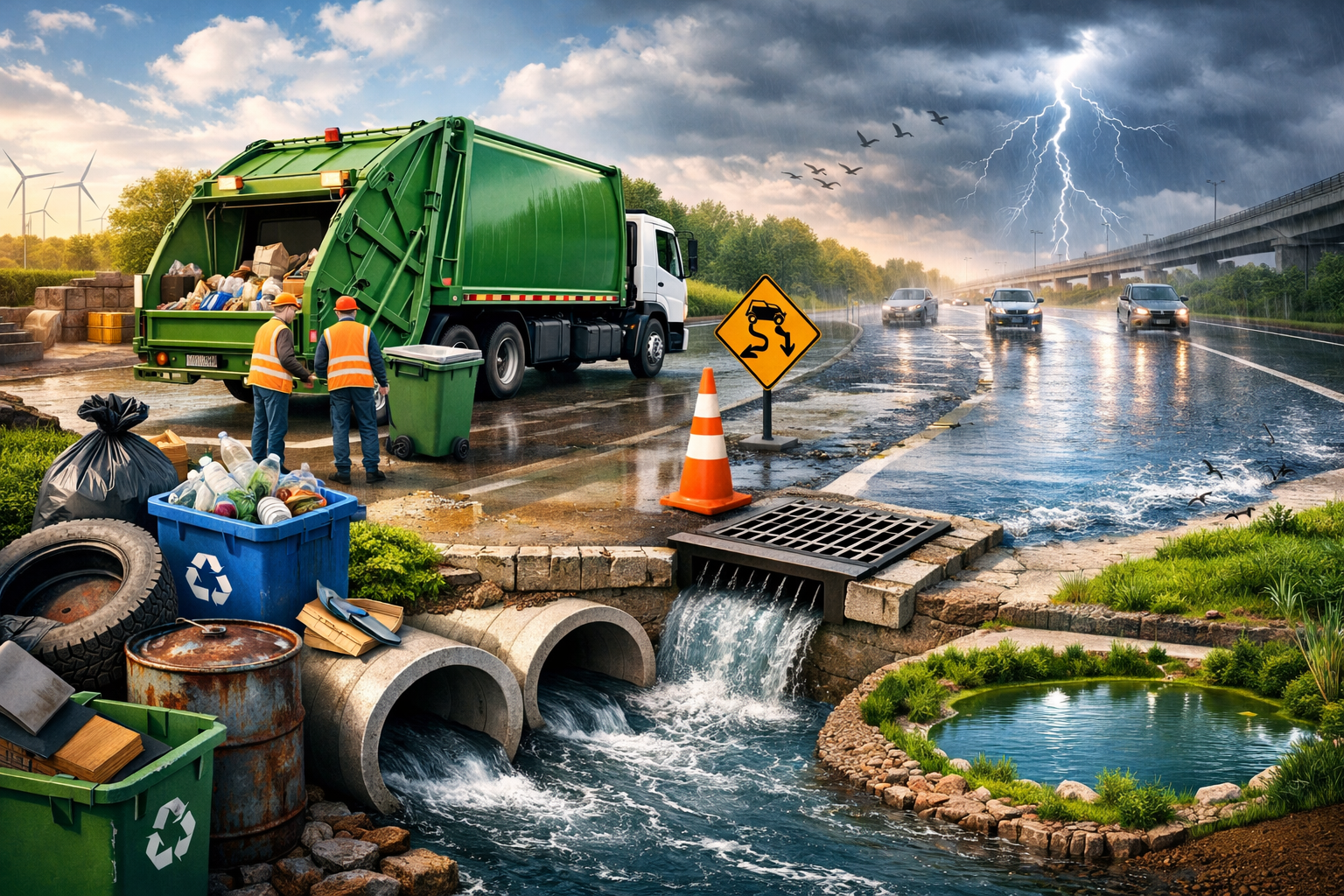
When people think of waste management services, they often picture residential bins or industrial skips. In the context of road infrastructure, however, waste management is a high-stakes operation focused on “Gross Pollutant Traps” and roadside maintenance. Roads naturally accumulate a diverse range of waste:
- Organic Matter: Leaf litter and branches that can make surfaces slick.
- Anthropogenic Litter: Plastics, cans, and glass that obstruct drainage.
- Industrial Byproducts: Microplastics from tyres and leaked hydrocarbons.
If left unmanaged, this waste doesn’t just sit there; it migrates. Professional waste management ensures that roadside bins are serviced and, more importantly, that the illegal dumping of construction waste is mitigated. Without these services, debris becomes a projectile hazard or a physical barrier, increasing the risk of accidents.
Stormwater Management: Preventing the “Aquaplaning” Effect
Stormwater management is the practice of controlling the runoff generated by rain. In Australia, our urban environments are heavily “impermeable”, meaning water cannot soak into the ground. Instead, it rushes across the road surface. Effective stormwater design involves a network of pits, pipes, and culverts designed to whisk water away from the bitumen as fast as possible. If these systems fail, we see two immediate threats to road safety:
- Aquaplaning: A thin layer of water builds up between the tyres and the road, causing the driver to lose steering and braking control.
- Structural Erosion: Water that sits on a road seeps into the sub-grade, causing the soil to soften. It leads to the Australian driver’s greatest enemy: the pothole.
The Intersection: Where Waste Meets Water
The most critical point of failure for Australian roads is where waste enters the stormwater system. This is why waste management services are now being integrated directly into civil engineering schedules. When litter and organic waste enter the drains, they cause “clogs.” During a heavy downpour, a clogged drain is as good as no drain at all. The water backs up, flooding the carriageway and turning a standard commute into a hazardous crossing.
The Role of Gross Pollutant Traps (GPTs)
To combat this, many Australian councils utilise GPTs. These are large-scale “filters” installed within the drainage network. They catch the heavy waste before it reaches our waterways or causes a backup. However, these traps require regular vacuum loading and specialised waste disposal—proving that effective road safety is an ongoing cycle of maintenance, not a “set and forget” installation.
Environmental Stewardship on the Move
Safe roads shouldn’t come at the cost of our ecosystems. Australia’s “Water Sensitive Urban Design” (WSUD) principles aim to treat stormwater as a resource rather than a nuisance. By using bio-retention swales (vegetated ditches) alongside roads, we can filter out heavy metals and oils before the water reaches the Great Barrier Reef or the Murray-Darling Basin. Professional waste management ensures these swales don’t become clogged with trash. Hence, allowing the plants to do their job of purifying the water and slowing its flow, which further protects the road’s edges from crumbling.
Conclusion: A Collaborative Approach
Securing Australia’s roads requires a holistic view of the landscape. It isn’t just about the engineers who design the curves or the police who monitor the speed; it is about the waste management services that keep the arteries of our cities clear. The stormwater experts who respect the power of the Australian climate also play a crucial role. By investing in clean drains and consistent waste removal, we aren’t just protecting the environment—we are saving lives on the bitumen.
FAQs
1. How does waste affect road drainage?
Litter and organic debris block grates and pipes, causing water to pool on the road, which leads to flooding and aquaplaning.
2. What are “Gross Pollutant Traps” (GPTs)?
GPTs are underground systems designed to catch large pieces of waste and sediment from stormwater before they enter natural waterways.
3. Why is standing water dangerous for roads?
Beyond the risk of sliding, standing water penetrates the road surface, weakening the foundation and creating potholes.
4. How often should roadside drains be cleaned?
It depends on the area, but most Australian urban centres require professional clearing at least twice a year or after major storm events.
5. Can waste management improve road longevity?Yes. By keeping drainage clear, waste management services prevent the waterlogged conditions that cause asphalt to crack and erode.
Disclaimer
The information provided in this article is intended for general informational and educational purposes only. While every effort has been made to ensure the accuracy and relevance of the content, it does not constitute professional, legal, engineering, environmental, or safety advice. Road safety practices, waste management standards, and stormwater management requirements may vary by location, authority, and environmental conditions.
Readers should not rely solely on this article when making decisions related to infrastructure planning, waste management services, or stormwater systems. For site-specific guidance, compliance requirements, or risk assessments, consultation with qualified engineers, licensed waste management professionals, or relevant local and state authorities is strongly recommended.